English
 русский
Industry News
The short answer: a power bank charges small personal devices like phones and earbuds, while a portable power station — also called a portable energy storage pack — is a full-scale mobile energy system capable of running appliances, medical devices, power tools, and entire campsite setups. They are not the same product category, and choosing the wrong one for your situation can leave you underpowered at the worst possible moment.
As demand for reliable backup power and emergency power solutions grows — driven by increasing grid instability, outdoor recreation trends, and remote work lifestyles — the distinction between these two product types matters more than ever. This article breaks down every key difference so you can make a fully informed decision, whether you need a weekend camping energy storage pack or a serious power station for blackout protection at home.
What Is a Power Bank? Capabilities and Limitations
A power bank is a compact, pocket-sized rechargeable battery pack designed primarily for USB-based charging of smartphones, tablets, wireless earbuds, and smartwatches. Typical capacities range from 5,000 mAh to 30,000 mAh — the equivalent of roughly 18 to 110 Wh. They are lightweight, often under 500 grams, and extremely portable.
However, power banks have clear hard limits. They do not output AC power, meaning they cannot run any appliance that plugs into a wall outlet. They have no solar input capability in most models. They cannot power laptops at full load, run a mini-fridge, or serve as an emergency backup power for home use during a blackout. Their role is supplemental personal device charging — nothing more.
For travelers making short trips where only phone charging is needed, a power bank remains a practical, lightweight choice. But for anyone who needs to power anything larger than a laptop, the power bank category simply does not apply.
Energy Capacity Comparison: Power Bank vs Portable Power Station (Wh)
This chart illustrates the enormous gap in energy capacity between consumer power banks and portable power stations. Even a compact 300Wh entry-level power station stores nearly three times the energy of the largest consumer power bank. A mid-range 1000Wh portable energy storage pack stores roughly nine times more energy, while a 2000Wh unit — such as those used for emergency backup power for home scenarios — stores more than eighteen times as much. This difference is not marginal; it determines whether you can charge a phone once or run a refrigerator through the night.
What Is a Portable Power Station? Architecture and Real-World Output
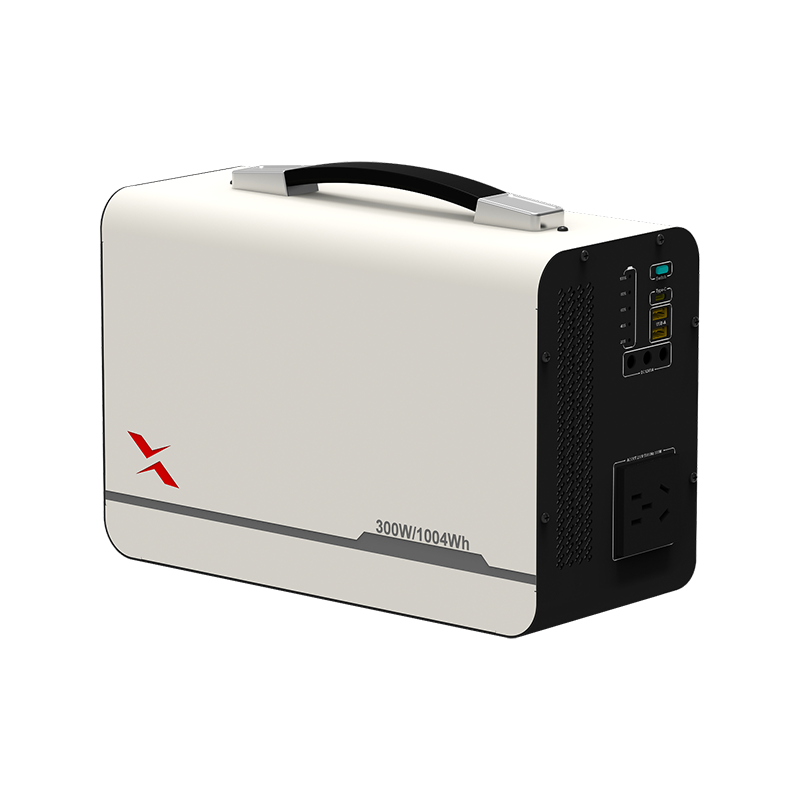
A portable energy storage pack is a self-contained mobile energy system built around a high-energy-density lithium-ion or LiFePO4 battery cell array, an integrated AC inverter, a battery management system (BMS), and multiple output interfaces. Units typically deliver 1 to 2 kWh of usable capacity, output 100–2000W of continuous AC power, and support DC outputs, USB-A, USB-C, and often car-style 12V DC ports simultaneously.
Unlike power banks, portable power stations are true off-grid power solutions. They can run refrigerators, CPAP machines, electric grills, LED lighting systems, power tools, laptop workstations, and medical equipment. They accept input from wall outlets, car 12V sockets, and — critically — external solar panels, making them the backbone of a complete solar generator for camping setup.
The built-in AC inverter is the defining feature that separates a power station from any other portable battery product. A pure sine wave inverter, found in quality units, produces clean electricity that is safe for sensitive electronics, medical devices, and motor-driven appliances — matching the quality of grid power. This is essential for a power station for CPAP use, where voltage irregularities can damage the machine or disrupt therapy.
| Feature | Power Bank | Portable Power Station |
|---|---|---|
| Typical Capacity | 5,000–30,000 mAh (18–110 Wh) | 200–5,000+ Wh |
| AC Output | No | Yes (100–2000W+) |
| Solar Input | Rarely / Limited | Yes (standard feature) |
| Weight | Under 500g | 3–30+ kg |
| Runs Appliances | No | Yes |
| Emergency Home Backup | No | Yes |
| Ideal For | Phone / tablet charging | Camping, blackouts, off-grid work |
LiFePO4 vs Lithium-Ion: The Battery Chemistry That Changes Everything
Battery chemistry is one of the most important — and most underexplained — factors in choosing a portable power station. Most power banks use standard lithium-ion (Li-ion) or lithium-polymer cells, which offer high energy density in a compact form but degrade relatively quickly: typically 300–500 full charge cycles before capacity drops noticeably.
Premium portable power stations increasingly use lithium iron phosphate (LiFePO4) cells. A LiFePO4 power station typically delivers 3,000 to 6,000 charge cycles before reaching 80% capacity — roughly 8 to 16 years of daily use. LiFePO4 chemistry is also significantly more thermally stable, dramatically reducing the risk of thermal runaway (battery fire), which is a real concern with high-capacity Li-ion packs under heavy load or improper charging.
For a camping energy storage pack that will experience outdoor temperature swings, or an emergency power unit stored for months between uses, LiFePO4 chemistry provides both safety and reliability advantages that justify the premium. The zero-power shutdown technology in advanced units further protects stored charge during long idle periods — ensuring the unit is ready when you actually need it.
Battery Capacity Retention Over Charge Cycles: LiFePO4 vs Li-ion
This line chart shows how battery capacity retention differs dramatically between LiFePO4 and standard lithium-ion chemistry over thousands of charge cycles. While both begin at 100% capacity, Li-ion cells in power banks drop below 80% — generally considered the end of useful life — after approximately 2,000 cycles at best. A quality LiFePO4 power station, by contrast, maintains above 85% capacity at 4,000 cycles, with some premium units rated to 6,000 cycles. For anyone buying a portable energy storage pack as a long-term investment for home backup or regular camping use, this difference in cycle life is a compelling economic and practical argument for LiFePO4.
Use Case Match: When to Choose a Power Bank vs a Power Station
The most common buyer mistake is either over-buying (a massive power station for phone-only use) or severely under-buying (a power bank for a camping trip that includes a cooler and lighting). The guide below maps scenarios to the right product category.
Choose a Power Bank When:
- You only need to charge a smartphone, earbuds, or smartwatch on the go
- You are on a day hike, short flight, or urban commute where weight is the priority
- Your total energy need is under 100 Wh per day
- You have no appliances, lights, or AC-powered devices to run
Choose a Portable Power Station When:
- You need a solar generator for camping that can recharge from a solar panel during multi-day trips
- You want a reliable power station for blackout scenarios at home — keeping the router, lights, or fridge running
- You use a CPAP machine and need a power station for CPAP that delivers stable, clean AC output overnight
- You work remotely in locations without grid power and need a full off-grid power solution for laptop, monitor, and networking gear
- You need emergency backup power for home to protect medical equipment, refrigerated medicine, or smart home systems during outages
- You want a quiet generator alternative that operates silently — essential for campsites with noise restrictions or indoor use
Capability Radar: Power Bank vs Portable Power Station
The radar chart above compares power banks and portable power stations across six critical performance dimensions. The power station (dark green) dominates in energy capacity, appliance power, solar charging compatibility, and emergency readiness — the four dimensions that matter most for real-world off-grid and backup scenarios. The power bank (light green) leads only in physical portability, reflecting its compact, pocket-friendly form factor. For anyone whose use case extends beyond charging a single device, this visual confirms that a camping energy storage pack or home emergency power system built around a portable power station is the only functionally adequate choice.
Solar Charging: A Feature That Separates the Categories Entirely
The ability to recharge from solar panels is one of the most decisive features separating a portable power station from a power bank. While some specialized power banks include a small integrated solar panel on their back cover, the charging rate from such panels is negligible — typically 2 to 5 watts, enough to extend battery life by a small margin but not to meaningfully recharge the unit in any practical timeframe.
A true solar generator for camping built around a quality energy storage pack accepts external solar panels rated at 100 to 400+ watts through a dedicated MPPT (Maximum Power Point Tracking) solar charge controller. MPPT technology optimizes energy harvest from the panels, maximizing efficiency even under partially cloudy conditions. A 200W solar panel connected to a 1000Wh power station can fully recharge the unit in 5 to 7 hours of adequate sunlight — enough to restore full capacity in a single camping day.
This solar recharging capability transforms a portable power station into a genuinely off-grid power solution — one that does not rely on grid access and can theoretically run indefinitely as long as sunlight is available. For extended camping trips, overlanding expeditions, remote work sites, or regions prone to prolonged grid outages, this closed-loop solar charging loop is a fundamental capability no power bank can approach.
Estimated Runtime on a 1000Wh Portable Power Station by Device
This column chart estimates runtime for common devices running from a single 1000Wh portable energy storage pack. Low-draw devices like LED camp lights or smartphones can run for 50+ hours, while moderate loads like a CPAP machine cover multiple nights of sleep therapy on a single charge. A mini-fridge — one of the most common appliances campers and emergency preppers want to power — runs approximately 12 hours, and a laptop covers a full 15-hour workday. These numbers illustrate why a 1000Wh unit is often described as the practical minimum for a serious camping energy storage pack or home emergency power setup.
Portable Power Station as a Quiet Generator Alternative
One of the most underappreciated advantages of a quality portable power station is its silence. Traditional gas-powered generators operate at 65 to 80 decibels — comparable to a lawnmower — making them inappropriate for campgrounds with noise ordinances, residential neighborhoods during blackouts, and any indoor application. They also produce carbon monoxide, requiring outdoor-only use.
A quiet generator alternative built on a portable power station operates at under 45 dB — quieter than a normal conversation — and produces zero emissions. This enables use in tents, RVs, apartments, garages, and any indoor space without ventilation concerns. For campsites with 10pm quiet hours, for families with sleeping children, or for office environments where generator noise would be disruptive, the acoustic difference alone justifies choosing a power station.
Additionally, portable power stations require no fuel storage, no engine maintenance, no oil changes, and no spark plug replacements. The operational simplicity — charge, store, deploy — is a meaningful practical advantage over gas generators, particularly for infrequent users who store the unit for months between emergencies.
Noise Level Comparison: Power Sources (dB)
Noise level is a decisive factor for many buyers comparing power sources. At 70 dB, a standard gas generator exceeds the noise threshold enforced at most campgrounds and residential areas during night hours. An inverter generator is quieter at ~55 dB but still audible at distance. A portable power station operating at approximately 40 dB — the ambient noise level of a quiet library — is fully compatible with overnight camping, hospital environments, and shared living spaces. The practical difference between 40 dB and 70 dB is not linear: at the decibel scale, 70 dB represents eight times the acoustic energy of 40 dB, making the generator significantly more disruptive than the raw numbers alone suggest.
About Nxten: OEM/ODM Portable Energy Storage Solutions
Nxten is strategically positioned in China's key energy manufacturing hub, providing direct access to global new energy supply chains. As a professional OEM portable energy storage pack manufacturer and ODM backup emergency power factory, Nxten serves international markets through a fully integrated supply chain that delivers 30% production efficiency gains and maintains Six Sigma quality standards across all product lines.
Nxten's IATF 16949 certified manufacturing facilities apply automotive-grade reliability standards to every portable energy storage unit produced. The in-house R&D center delivers customized energy solutions compliant with UL 1973, IEC 62619, and other international certifications — enabling buyers worldwide to deploy Nxten products with confidence in safety-regulated markets including North America, Europe, and Australia.
The core product line centers on mobile power systems featuring high-energy-density lithium-ion batteries with AC/DC output, 1–2 kWh capacity, solar panel input compatibility, and zero-power shutdown technology that preserves stored charge during extended storage. Vertical integration from component manufacturing to final distribution gives clients single-point accountability across the entire supply chain.
Frequently Asked Questions
Q1: Can I use a power bank instead of a portable power station for camping?
A power bank is suitable only for charging phones and small USB devices. If you need to run lights, a portable fridge, or recharge from solar panels, a camping energy storage pack with AC output is required. Power banks do not have the capacity or output needed for genuine campsite power.
Q2: How long can a portable power station run a CPAP machine?
A 1000Wh power station for CPAP can run most CPAP machines (30–60W average) for 16 to 33 hours, covering multiple nights without humidifier use. With humidifier enabled, power draw increases, so a 1000Wh unit still typically covers 1–2 full nights comfortably.
Q3: What is the advantage of LiFePO4 over regular lithium-ion in a power station?
A LiFePO4 power station offers 3,000–6,000 charge cycles vs 300–500 for standard Li-ion, far greater thermal stability (lower fire risk), better performance in cold temperatures, and more consistent capacity over its lifespan. For long-term backup or frequent camping use, LiFePO4 is the superior chemistry.
Q4: Can a portable power station be used indoors during a blackout?
Yes. Unlike gas generators, portable power stations produce zero emissions and operate silently, making them fully safe for indoor use during a power station for blackout situation. They can keep routers, lighting, refrigerators, and medical devices running without any ventilation requirements.
Q5: How do I recharge a portable power station while camping without grid access?
Connect external solar panels to the unit's solar input port. A 200W panel can fully recharge a 1000Wh solar generator for camping in 5–7 hours of good sunlight. Units with MPPT controllers optimize harvest even on partly cloudy days, making solar recharging a reliable daily option.
Q6: What size portable power station do I need for home emergency backup?
For basic emergency backup power for home covering a router, lights, phone charging, and a small fridge, a 1000–1500Wh unit covers most households for 8–12 hours. For extended outages or medical equipment dependency, a 2000Wh+ unit with solar recharging provides the most resilient off-grid power solution.