English
 русский
Industry News
Battery Energy Storage Systems: The Leading ESS Category
Battery-based Energy Storage Systems convert electrical energy into chemical energy for storage and release it on demand. Lithium-ion chemistry currently dominates the market due to its high round-trip efficiency, long cycle life, and compact form factor. Battery ESS can be deployed at every scale — from a 5 kWh residential wall-mount unit to a multi-megawatt grid-side container system.
Lithium Iron Phosphate (LFP) Batteries
LFP is the chemistry of choice for stationary energy storage. It offers excellent thermal stability, a cycle life typically exceeding 4,000 cycles at 80% depth of discharge, and inherent non-combustibility compared to other lithium chemistries. It is the core technology behind modern residential and commercial Energy Storage Systems, including off-grid hybrid systems that integrate solar PV, wind, and diesel backup.
Thermal Management: Air-Cooled vs. Liquid-Cooled ESS
Battery performance and lifespan are directly tied to thermal management. Two approaches are in widespread use:
- Air-cooled ESS — uses forced air circulation to dissipate heat. Lower upfront cost, simpler maintenance, suited to moderate-climate deployments and smaller-capacity systems.
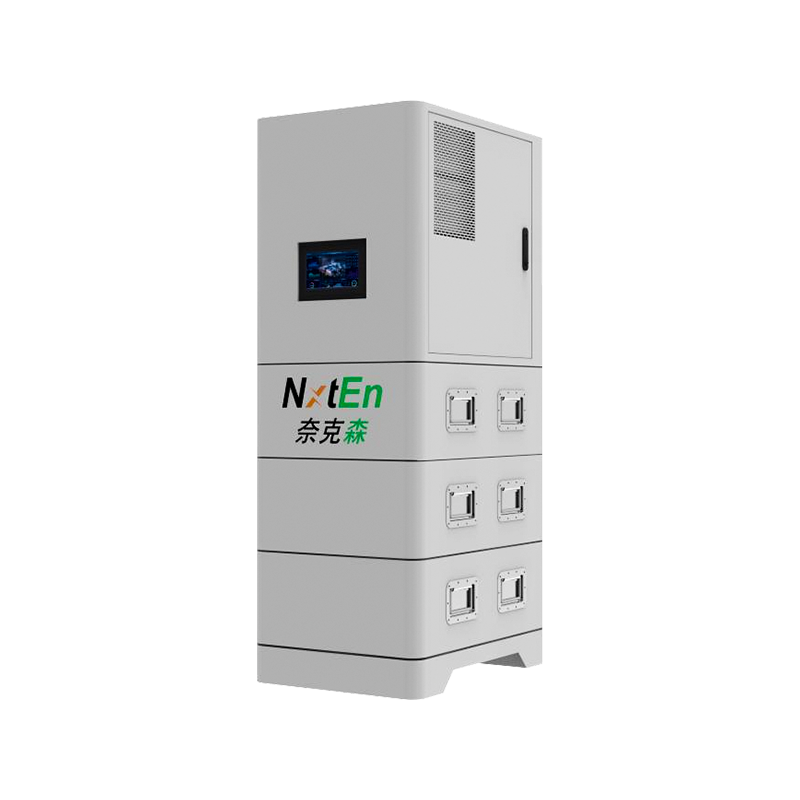
- Liquid-cooled ESS — circulates coolant through the battery pack to achieve tighter temperature control. It keeps cells within their optimal operating band even in high-temperature or high-power applications, reducing degradation and extending service life. Systems like the 430 kWh liquid-cooled commercial & industrial cabinet integrate the battery management system, thermal management, fire safety, and modular power conversion into a single plug-and-play outdoor enclosure.
For high-power applications such as EV fast charging, industrial equipment, and large-scale solar-storage integration, liquid-cooled Battery Energy Storage Systems are the engineering-preferred solution.
Six Types of Energy Storage Systems Compared
Understanding the full landscape of ESS types helps buyers match the right technology to the right application. The table below summarizes the key parameters of each major ESS category.
| ESS Type | Energy Form | Response Time | Scale | Best Application |
|---|---|---|---|---|
| Battery (Lithium-ion) | Chemical | Milliseconds | kWh – MWh | Residential, C&I, grid-scale |
| Pumped Hydro | Gravitational / Potential | Minutes | GWh | National grid balancing |
| Compressed Air (CAES) | Mechanical / Pneumatic | Minutes | MWh – GWh | Long-duration grid storage |
| Flywheel | Kinetic / Mechanical | Milliseconds | kWh | Frequency regulation, UPS |
| Thermal Storage | Heat / Cold | Hours | MWh | Concentrated solar, industrial heat |
| Hydrogen Storage | Chemical (H₂) | Minutes – Hours | MWh – TWh | Seasonal storage, heavy transport |
Pumped Hydro Storage: The World's Largest ESS by Installed Capacity
Pumped hydroelectric storage works by pumping water from a lower reservoir to an elevated one during periods of low electricity demand, then releasing it through turbines to generate power when demand peaks. It is the most mature long-duration energy storage technology in existence, accounting for the majority of global grid-scale storage capacity.
Its key limitation is geography: suitable sites require significant elevation differences and large water bodies, making it impractical for most distributed or urban applications. Construction timelines and capital costs are also very high. Pumped hydro is not a viable option for commercial, industrial, or residential ESS deployments — those applications require battery-based systems.
Compressed Air Energy Storage (CAES): Underground Long-Duration Storage
CAES systems use surplus electricity to compress air into underground caverns, depleted mines, or pressure vessels. When power is needed, the compressed air is released and expanded through turbines. CAES is suited to very large scale, long-duration applications — balancing seasonal generation surpluses from wind and solar farms.
Like pumped hydro, CAES is not scalable to building or site level. The geology requirement (large underground caverns), low round-trip efficiency compared to batteries, and slow response time make it unsuitable for peak shaving, backup power, or on-site renewable energy integration. It remains a niche grid-infrastructure technology.
Flywheel Energy Storage: Fast Response, Short Duration
Flywheel systems store energy as rotational kinetic energy in a spinning mass. They can absorb and release energy in milliseconds — making them exceptionally well-suited to power quality applications such as grid frequency regulation, voltage stabilization, and uninterruptible power supply (UPS) bridging.
The fundamental limitation of flywheels is low energy density and high self-discharge rate: stored energy dissipates within seconds to minutes even without a load. This makes them unsuitable for hours-long energy shifting (the core function of a residential or commercial ESS). Flywheels complement battery systems rather than replace them — handling the fast transient response while batteries carry the sustained load.
Thermal Energy Storage: Storing Heat and Cold for Industrial Use
Thermal ESS stores energy as heat or cold in materials such as molten salt, ice, or water. Concentrated solar power (CSP) plants use molten salt thermal storage to continue generating electricity after sunset. Ice-based cooling systems store chilled water during off-peak hours to reduce HVAC electricity demand during peak periods.
Thermal storage is highly application-specific. It is not interchangeable with electrical energy storage — it can only be discharged as heat or cold, not as electricity. For facilities that need to manage electrical loads, backup power, or integrate with solar PV systems, battery-based ESS remains the correct solution.
Hydrogen Energy Storage: Long-Duration Potential, Early-Stage Deployment
Green hydrogen is produced by using surplus renewable electricity to electrolyze water, splitting it into hydrogen and oxygen. The stored hydrogen can later be converted back to electricity via fuel cells or combustion turbines. Hydrogen's key advantage is its extremely high energy density by weight and virtually unlimited storage duration — making it a candidate for seasonal storage at scales no battery technology can currently address.
In practice, the round-trip efficiency of the electricity-to-hydrogen-to-electricity pathway is currently significantly lower than battery systems. Infrastructure costs (electrolyzers, storage tanks, fuel cells) remain high. Hydrogen ESS is a technology to watch for the 2030s and beyond, but for current commercial, industrial, and residential deployments, lithium-based battery ESS delivers superior economics and practicality.
Choosing the Right ESS Type for Your Application
The "right" Energy Storage System depends on three factors: the application scale, the required discharge duration, and the response speed needed. Here is a practical decision framework:
Residential
Daily solar self-consumption, backup power during outages, time-of-use tariff optimization. Recommended: Residential battery ESS (5–20 kWh, LFP chemistry, wall-mount or floor-standing).
Commercial & Industrial
Demand charge reduction, peak shaving, backup power, on-site renewable integration. Recommended: Liquid-cooled C&I battery ESS (100 kWh–MWh scale, modular outdoor cabinet, plug-and-play).
Off-Grid & Hybrid Microgrids
Remote facilities, islands, or areas with unreliable grid. Requires integration of solar PV, wind, battery storage, and optional diesel backup under a single intelligent energy management controller. Recommended: Off-grid hybrid Energy Storage System with multi-source coordination.
Grid-Scale Storage
Frequency regulation, peak-valley arbitrage, renewable energy curtailment reduction for utilities and power stations. Recommended: Large-format containerized battery ESS with grid-forming inverter capability.
Key Technical Parameters When Specifying a Battery ESS
When procuring a battery-based Energy Storage System, these are the parameters that determine whether the system will perform as required over its service life:
- Usable Capacity (kWh): The amount of energy actually accessible, accounting for depth-of-discharge limits. Always verify usable vs. nominal capacity.
- Rated Continuous Power (kW): The maximum sustained output. A system with 430 kWh capacity and 200 kW rated power can deliver full power for roughly 2 hours under continuous load.
- Round-Trip Efficiency (%): The ratio of energy discharged to energy charged. Higher efficiency means less wasted electricity per cycle.
- Cycle Life (cycles @ DoD): The number of charge-discharge cycles before capacity falls below the warranty threshold, always specified at a defined depth of discharge.
- Battery Management System (BMS): Controls cell balancing, state-of-charge estimation, over-temperature and over-current protection. A robust BMS is the primary safety layer of any battery ESS.
- Thermal Management Method: Air-cooled or liquid-cooled, directly affecting high-temperature performance and long-term degradation rate.
- Certifications: Compliance with UL 1973, IEC 62619, and other regionally required standards is non-negotiable for insurance, grid interconnection, and safe operation.
How to Source a Reliable Energy Storage System
The performance of an ESS over its 10–15 year service life depends as much on manufacturing quality as on system design. When evaluating suppliers, prioritize the following:
- Vertical integration — a manufacturer that controls the supply chain from cell through module, pack, and system level can guarantee component traceability and consistent quality.
- IATF 16949 or equivalent quality system — automotive-grade manufacturing discipline applied to energy storage production is a strong indicator of process rigor.
- OEM/ODM capability — the ability to customize system capacity, enclosure configuration, communication protocols, and certifications for your specific market and application.
- International standards compliance — UL 1973, IEC 62619, and CE certifications are prerequisites for most commercial and industrial deployments in regulated markets.
- Global after-sales support — a network of regional service partners and multilingual technical support ensures issues are resolved without extended downtime.
Explore NxtEn's Complete ESS Product Range
From residential battery packs and liquid-cooled commercial cabinets to off-grid hybrid systems and grid-scale solutions — NxtEn offers vertically integrated, UL/IEC-certified Energy Storage Systems with full OEM/ODM customization. Headquartered in Zhejiang, China's new energy hub, with global after-sales coverage.