
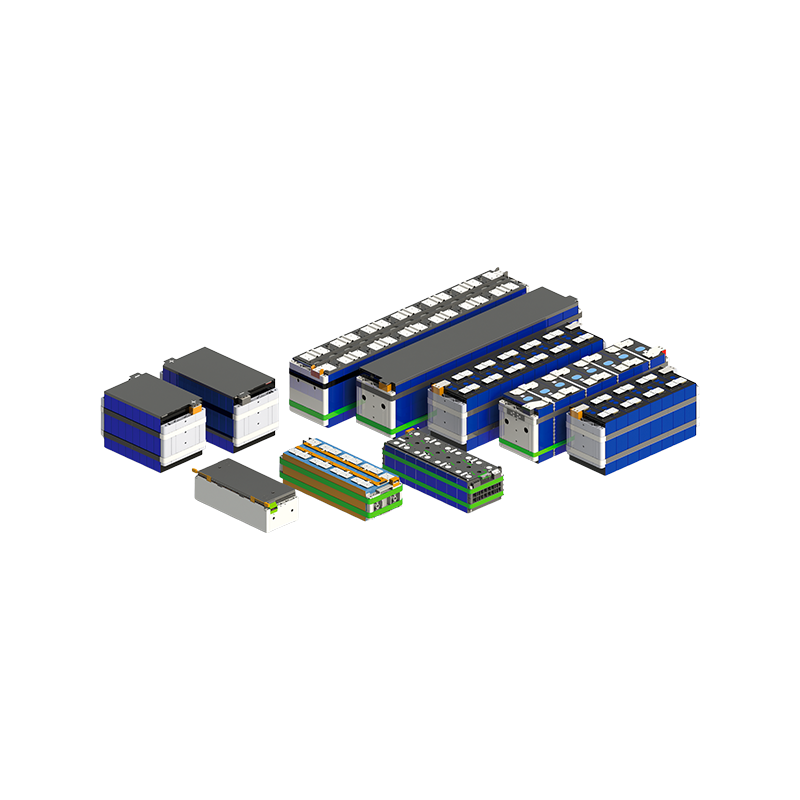
Product Introduction:
Lithium battery modules combine dozens to hundreds of battery cells in series or parallel, combined with a specialized battery management system (BMS), thermal management components, and mechanical structure to form a complete and safe energy supply system. This integrated design enables previously separate cells to work together. The modular design not only improves overall energy density but also lays a solid foundation for the large-scale application of battery systems.
In actual use, strict operating specifications must be adhered to: ensuring operation within the specified voltage and temperature ranges, avoiding overcharge and over-discharge, and performing regular system balancing maintenance. Advances in intelligent manufacturing technology have achieved breakthroughs in energy density, cycle life, and safety performance. The module's internal flame-retardant materials and explosion-proof design mitigate risks even in challenging circumstances. Furthermore, the modular design facilitates subsequent reuse. If a battery module no longer meets the initial application requirements, it can continue to function in backup power, low-speed electric vehicles, and other applications, maximizing its value throughout its lifecycle.
Advantages and Features:
1. High Space Utilization
This module is not simply a physical stack of cylindrical or prismatic cells. Instead, it optimizes the cell layout, connections, and integration with the cooling system based on in-depth thermodynamic simulation and structural mechanics analysis. This stacked design maximizes internal volume, directly increasing energy density from the "cell level" to the "system level." By eliminating redundant structures and optimizing internal wiring layout, the design goal of "higher energy within the same volume" is achieved.
2. Safety and Reliability
The safety of the Nexon module is embodied in a multi-layered intelligent system, built from the inside out:
Cell-level temperature monitoring transcends the limitations of traditional modules that only monitor overall status.
3. Standardized Deployment and Plug-and-Play
This "plug-and-play" design concept revolutionizes the deployment of energy storage systems. The module integrates standardized sampling interfaces.
4. High-Level Fire Protection
Physical Isolation: Advanced fire-resistant materials such as ceramic fiber are used between cells and in critical thermal insulation areas of the module. They act like built-in "firewalls," tightly confining potential hazards to a small, localized area, preventing catastrophic chain reactions and buying valuable time for emergency response.
Application Scenarios:
● Residential and small commercial energy storage systems
● Electric vehicle (EV) charging station energy storage
● Mobile and portable energy storage
● Backup power for data centers and communication base stations
● Industrial automation and material handling
Nxten lithium battery module with space-saving stacked design, featuring cell-level temperature monitoring and fireproof materials for plug-and-play secure deployment.
Features:
● Safety & Reliability
● Standardized Deployment
● Optimized Spatial Efficiency
● Advanced Fire Protection
| Model | 100-1P8S | 100-1P12S | 150-1P8S | 150-1P10S | 205(230)-1P8S | 205(230)-1P10S | 205(230)-1P12S | 280(314)-1P8S | 280(314)-1P12S | 280(314)-1P13S |
| Rated Voltage | 25.6V | 38.4V | 25.6V | 38.4V | 25.6V | 32V | 38.4V | 25.6V | 38.4V | 41.6V |
| Rated Capacity | 100Ah | 100Ah | 150Ah | 150Ah | 205/230Ah | 205/230Ah | 205/230Ah | 280/314Ah | 280/314Ah | 280/314Ah |
| Rated Current/Power@25±2℃ | 50A(0.5C) | 50A(0.5C) | 75A(0.5C) | 75A(0.5C) | 103/215A(0.5C) | 103/215A(0.5C) | 103/215A(0.5C) | 448/502.4W(0.5P) | 448/502.4W(0.5P) | 448/502.4W(0.5P) |
| Cycle Life(Capacity≥80%) | ≥6000 | ≥6000 | ≥6000 | ≥6000 | ≥6000 | ≥6000 | ≥6000 | ≥6000 | ≥6000 | ≥6000 |
| Dimensions(W*D*H) | 470.56*78*124mm | 576.2*78*124mm | 318.4*201.3*215.5mm | 386*201.3*215.5mm | 482.56*175*208.2mm | 591.2*175*208.2mm | 651.84*175*208.2mm | 626.4*175*211.8mm | 915.6*175*211.8mm | 987.9*175*211.8mm |
| Weight | 17.8±0.5kg | 21.7±0.5kg | 27±0.5kg | 33±0.5kg | 36.6/38.7±0.5kg | 45/47.1±0.5kg | 53.4/55.5±0.5kg | 48.2/50.7±0.5kg | 70.8/73.3±0.5kg | 77.5/80±0.5kg |
 About Nxten
0㎡

0+

0+

0+
What’S News



Lithium iron phosphate batteries, as a core component of modern energy storage systems, electric transportation equipment, and various distributed energy systems, are structured power units composed of dozens to hundreds of battery cells connected in series or parallel. Compared to a single battery cell, a module has higher voltage, larger capacity, and more stable output performance. Through the deep integration of a dedicated battery management system (BMS), thermal management components, and mechanical structure, it forms a complete, safe, controllable, and maintainable energy supply system. This integrated design not only enables previously independent battery cells to work collaboratively and efficiently but also serves as the basic unit for building battery packs and large-scale energy storage power stations, laying a solid foundation for the application of lithium batteries in a wider range of scenarios.
Modular design is the core advantage of lithium battery modules. Through precise layout and optimized electrical structure, battery modules significantly improve overall energy density while maintaining a compact size, enabling the system to provide stronger energy output within a limited space. Whether used to store photovoltaic power in home energy storage systems, as a power source in electric vehicles, or for peak shaving, emergency power supply, and frequency regulation in industrial energy storage projects, battery modules provide stable and efficient energy support. Their modular structure not only facilitates expansion but also allows for flexible configuration of capacity and output to meet diverse application needs, making the system highly adaptable.
To ensure high reliability and safety, the integrated Battery Management System (BMS) plays a crucial role. The BMS monitors the voltage, current, temperature, and health status of each battery cell in real time and maintains cell consistency through balancing strategies, preventing dangerous conditions such as overcharging, over-discharging, and overheating. Simultaneously, a module-level thermal management system ensures the battery operates within a suitable temperature range, effectively controlling temperature rise and temperature difference through air cooling, liquid cooling, or phase change material design, thereby extending battery life and improving cycle performance. Furthermore, the module incorporates multiple safety structures, including flame-retardant materials, thermal insulation layers, and explosion-proof valves, effectively reducing safety risks even under harsh conditions such as high temperatures, impacts, and vibrations, significantly improving the overall system's safety and durability.
The development of intelligent manufacturing technology has brought about a leapfrog improvement in the performance of lithium battery modules. Through more advanced cell material systems, more refined structural processes, and more efficient automated production processes, modern lithium battery modules have significantly improved in energy density, cycle life, safety, and consistency. Higher consistency allows the module to maintain more stable output characteristics during long-term operation, reducing failures and performance degradation caused by cell differences. Thanks to these technological advancements, battery modules can now provide reliable support in demanding application scenarios such as energy storage power stations, grid-side frequency regulation, and fast charging of electric vehicles.
In practical applications, operating procedures are crucial to the lifespan and performance of lithium battery modules. It is essential to ensure that the module operates within the specified voltage, temperature, and charge/discharge rate ranges, strictly avoiding overcharging and over-discharging to prevent irreversible electrochemical damage. Simultaneously, regularly checking the system's operating status and performing equalization maintenance helps maintain the consistency of the cells within the module, slowing down the degradation process. Adhering to procedures not only improves system safety but also extends service life, thereby reducing overall operating costs.
It is worth noting that modular design also provides possibilities for the later reuse of lithium batteries. Even when a battery module no longer meets the capacity and performance standards required for its initial application (such as an electric vehicle powertrain), it can still play a role in energy storage, for example, as a backup power source for homes, a battery for low-speed electric vehicles, or a power source for agricultural irrigation equipment. This "cascade utilization" model maximizes the value of the battery module throughout its entire lifecycle, reduces resource waste, and promotes the development of a green circular economy.
Ningbo Nxten Energy Technology Co., Ltd. is a professional lithium battery module manufacturer. Our lithium battery modules, with their high energy density, excellent safety performance, strong adaptability, and scalability, have become a key basic unit in new energy systems.

 +86-0574-62165160
 +86-18958222822
 No. 95-1, South Guangming Road, Simen Town, Yuyao City, Zhejiang Province, China



 English
 русский